The Time Telling
The Time Telling
About the project
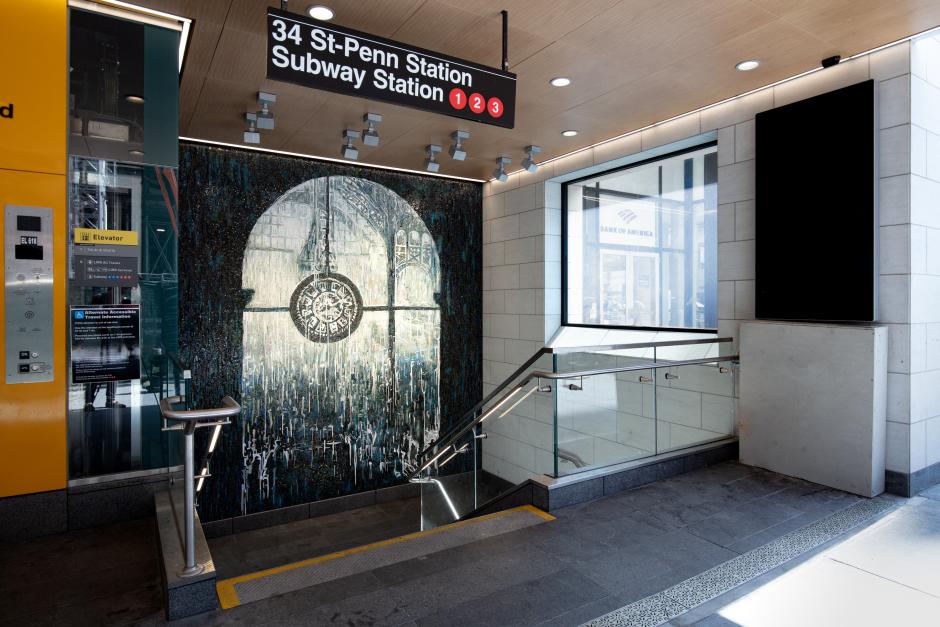
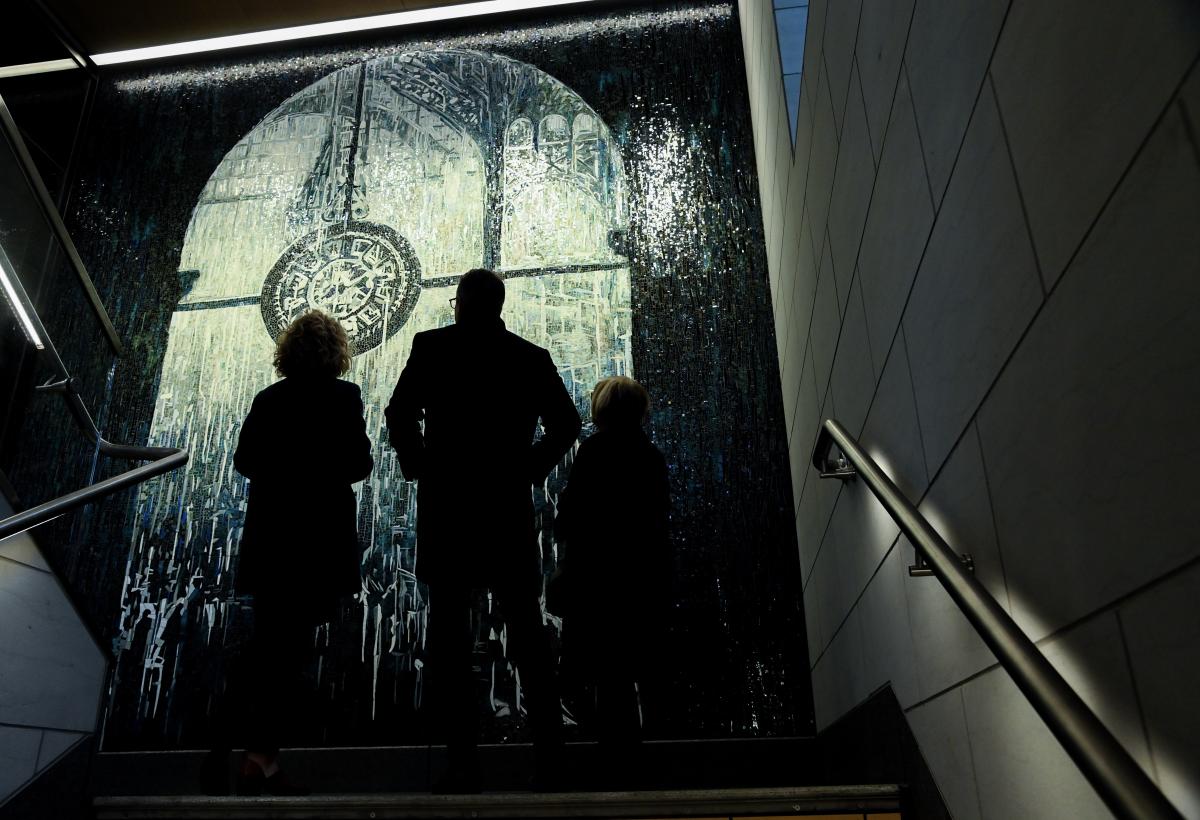
Diana Al-Hadid’s “The Time Telling” is located near 33 St and 7 Avenue, inside the ADA-accessible street-level entrance to 34 St-Penn Station . The glass mosaic, measuring 14’-9” high by 14’-1” wide, was inspired by Alfred Eisenstaedt’s iconic photograph of the clock that once hung at the entrance of the original Pennsylvania Station. In the photograph, light streams through the windows, creating a visual effect of a veil of mist or fog as commuters cross the busy station floor.
Al-Hadid reimagines the scene through her expressive, gestural mark making. Her interpretation blurs the boundaries between figuration and abstraction, evoking a scene that feels drawn from our collective memories of a historic space, real or imagined. The line work is fluid, not fixed. “The Time Telling” references a clock forever associated with the original Pennsylvania Station, inviting viewers to step into a moment where past and present meet and offering today’s riders a connection to an earlier era.
“The Time Telling” complements two earlier mosaics by Al-Hadid, commissioned by MTA Arts & Design in 2018 and located at the control area for the 1, 2, and 3 trains. “The Arches of Old Penn Station” is based on an image of the grand interior of the 1910 Beaux-Arts station, and “The Arc of Gradiva,” portraying Gradiva, a mythological figure who passes through walls and wanders ancient ruins like an apparition. Fabricated by Mayer of Munich, the three mosaics are rendered in shimmering aquas, metallic tones, and iridescent hues. Each work reflects Al-Hadid’s signature gestural lines, drips, and textured atmospheres— marks that echo the passage of time.
About the artist
Diana Al-Hadid is a Syrian-American artist living in Brooklyn, New York, who creates sculptures, installations, panels, and drawings using various media such as polymer gypsum, plaster, fiberglass, wood, and steel. Al-Hadid creates structures that simultaneously soar and dissolve in space, blurring the boundaries between figuration and abstraction. She sources conceptual ideas and imagery from literature, history, anatomy, architecture, cosmology, and physics. Her rich, formal allusions cross cultures and disciplines, taking inspiration from her Syrian background, as well as ancient Rome, the Renaissance, or Mannerist painting.