Swap Creates Smoother Rides and Reduces Delays on by Simplifying Routing Through Queens Plaza
1.2 Million Riders on Lines Will Benefit from More Reliable Trips
See Video of Today’s Event
See New Weekday Service Map and Photos of Today’s Event
See B-Roll of Customer Ambassadors
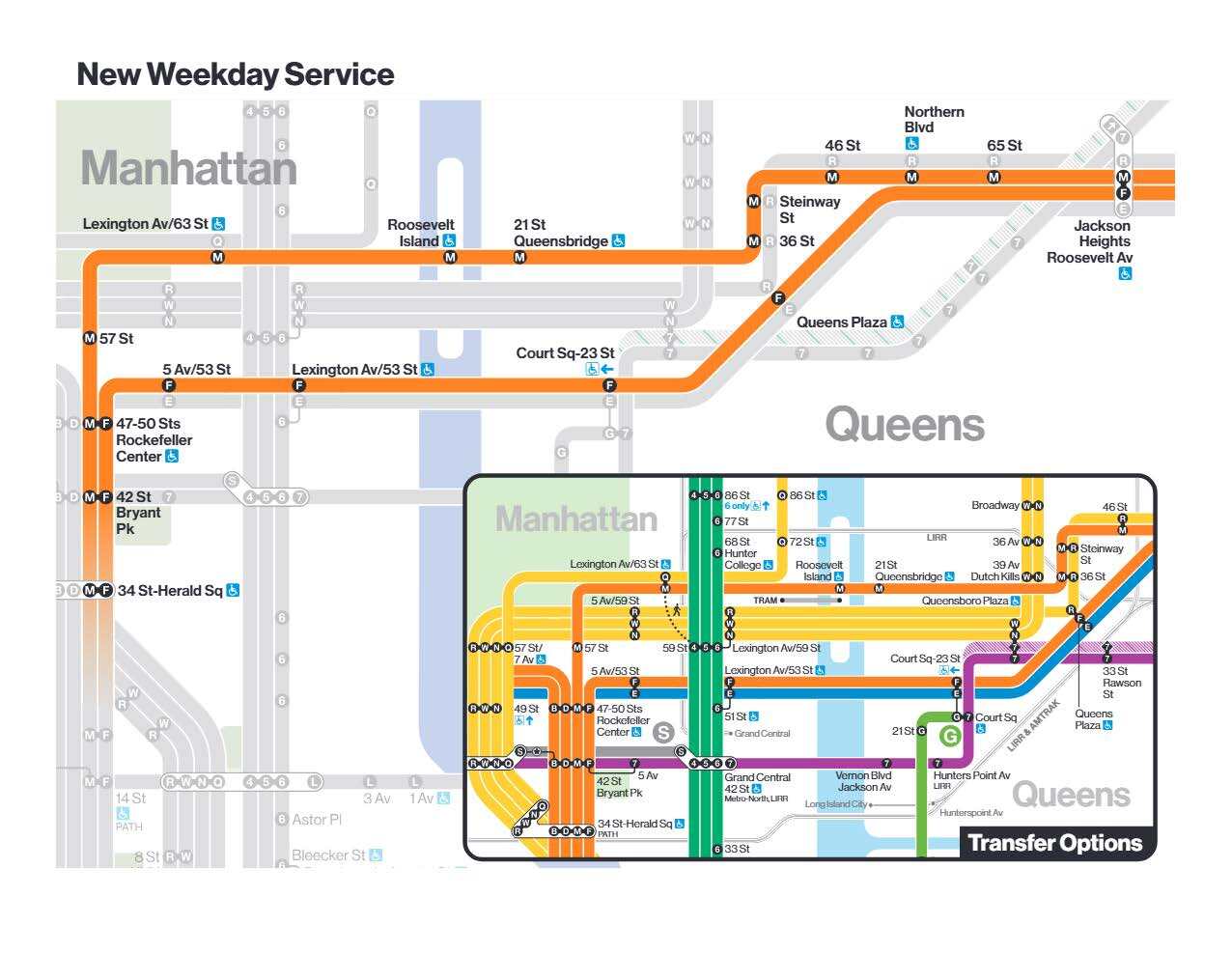
The Metropolitan Transportation Authority (MTA) today is reminding the public that starting on Monday, Dec. 8, New York City Transit will swap and train service on weekdays between 6:00 a.m. and 9:30 p.m. at four stations on each line in Manhattan, Queens, and Roosevelt Island. By eliminating a merge at Queens Plaza that has caused delays, the change will improve service on the lines, providing more consistent running times and better on-time performance for the 1.2 million riders who use these lines every day.
The route swap was presented to the MTA board and will go into effect on Dec. 8. Customers can learn more about the service change at mta.info/fmswap
The new service pattern between the Queens Boulevard corridor and Manhattan will be in effect weekdays from approximately 6:00 a.m. to 9:30 p.m. During these times, the will run via the 53 St line and Queens Plaza, alongside the .
During this time, trains will now make stops at the following stations:
-
Queens Plaza
-
Court Sq-23 St
-
Lexington Av/53 St
-
5 Av/53 St
The will run via the 63 St line and Roosevelt Island on weekdays from approximately 6:00 a.m. to 9:30 p.m. and will now make stops at the following stations:
-
21 St-Queensbridge
-
Roosevelt Island
-
Lexington Av/63 St
-
57 St
There will be no change from current service late evenings, nights, and weekends.
The service change is expected to improve reliability of service for all Queens Boulevard line trains () by eliminating the shared track segment between the and .
When the swap goes into effect:
-
trains will share a track with two lines (down from three)
-
trains will share tracks with three lines (down from four)
By eliminating the merges at Queens Plaza, any delays to or local trains would now be isolated from express service and vice-versa. Under the current service plan, approximately 15-20% of rush hour trains are delayed at Queens Plaza.
“More than a million customers rely on the Queens Boulevard line every weekday – more daily riders than Philadelphia’s entire transit system,” said MTA Chair and CEO Janno Lieber. “Swapping the and gives them a more reliable ride by untangling a known chokepoint to increase capacity and keep trains moving faster.”
“NYC Transit continues to prioritize safe and reliable service and this change achieves that with better service reliability, operational flexibility and resiliency,” said NYC Transit President Demetrius Crichlow. “Implementing this swap has a real impact on the 1.2 million riders who will experience the benefit of more reliable trips for themselves.”
“Swapping the routes the and take between Queens and Manhattan eliminates merge points that will translate to more reliable service for and riders,” said NYC Transit Executive Vice President of Subways Bill Amarosa Jr. “At New York City Transit we are always looking for ways to improve service, and this is an example of our efforts to utilize the data at our fingertips to make informed decisions about the service we provide.”
“This is a big change, and we’ve made it a top priority to make sure customers know everything about it,” said MTA Chief Customer Officer Shanifah Rieara. “We’ve done a ton of community outreach, on trains, in stations in our app and on the MTA website. Our amazing customer ambassadors will be on hand to talk riders through the changes face to face.”
“This service change is a part of the MTA’s goal to increase frequency and accessibility of transportation for working class New Yorkers,” said New York State Senator Kristen Gonzalez. “I’m so proud of the work our legislature has done to fund projects like this, and I look forward to continuing to partner with the MTA to achieve their goals, while staying communicative with the public on these changes.”
"Queens residents deserve a speedy and smooth ride on the subway, and these changes will help get them that," said Queens Borough President Donovan Richards Jr. "I'm grateful for the MTA's partnership in ensuring a quicker ride with fewer delays for our commuters who rely on the and lines to get to work, school, home and beyond."
“Whether they are headed home, or to work, or to school, reliable public transportation is vital for our island community,” said Roosevelt Island Operating Corporation President & CEO B.J. Jones. “The anticipated reduction in overly crowded trains as a result of this line switch will be a welcome improvement. We’re grateful to the MTA for continuing to explore new ways to enhance the rider experience to and from Roosevelt Island.”
This service change is part of the MTA’s commitment to the many communities it serves. It will increase reliability by improving service and reducing delays on the lines for all customers in Queens and Roosevelt Island, the majority of whom will see a travel time savings. Trains serving Roosevelt Island and 21 St–Queensbridge will be less crowded. M train riders will see additional peak hour service.
These service changes follow the Re-NEW-vation program at Roosevelt Island’s station completed in October 2024 that saw the station get a deep cleaning, more than 10,000 sq. feet of surfaces repainted including the exterior façade, all light fixtures converted to more efficient LED lights, and many other improvements.
The MTA used multiple platforms for advance notification to riders of the changes with nearly 500 customer ambassador shifts and 300,000 brochures distributed.
The agency also used:
-
Maps
-
“Look ahead” posters
-
Website and digital feeds
-
Announcements
-
Onboard train signage and electronic strips maps
-
Digital screens
-
Station signage
The swap will also enable the MTA to make much-needed improvements at the 21 St-Queensbridge station including:
-
Installing additional light fixtures and new signage both outside and inside the station
-
Painting
-
Placing ADA tactile strips on the platform
-
Resurfacing and polishing glass surfaces
-
Repairing broken floor tiles
-
Renewing old and installing new drainage
-
Fabricating and installing new canopies over two staircases to protect riders from bad weather