About bus network redesign
Bus network redesign is a collaborative planning effort to determine where today's bus service should go.
A bus network redesign includes changes to the routes, bus stops, frequencies, and spans of service in a way that responds and adapts to rider travel patterns and reallocates available resources to where they will have the greatest impact. With feedback from stakeholders and riders, we are improving and simplifying the current network to get people where they want to go more quickly and efficiently. Because of the size and complexity of the New York City bus network, we’re tackling these projects at the borough level.
Changes outside of the redesign process
You may notice smaller changes to bus service outside of the redesign process. While network redesigns are the most transformative visions for bus service, routes and bus stops may still change as part of regular bus service planning. Factors such as construction, community concerns, bus priority projects, or operational improvements may result in changes before or after a redesign is implemented.
Why we redesign the bus network
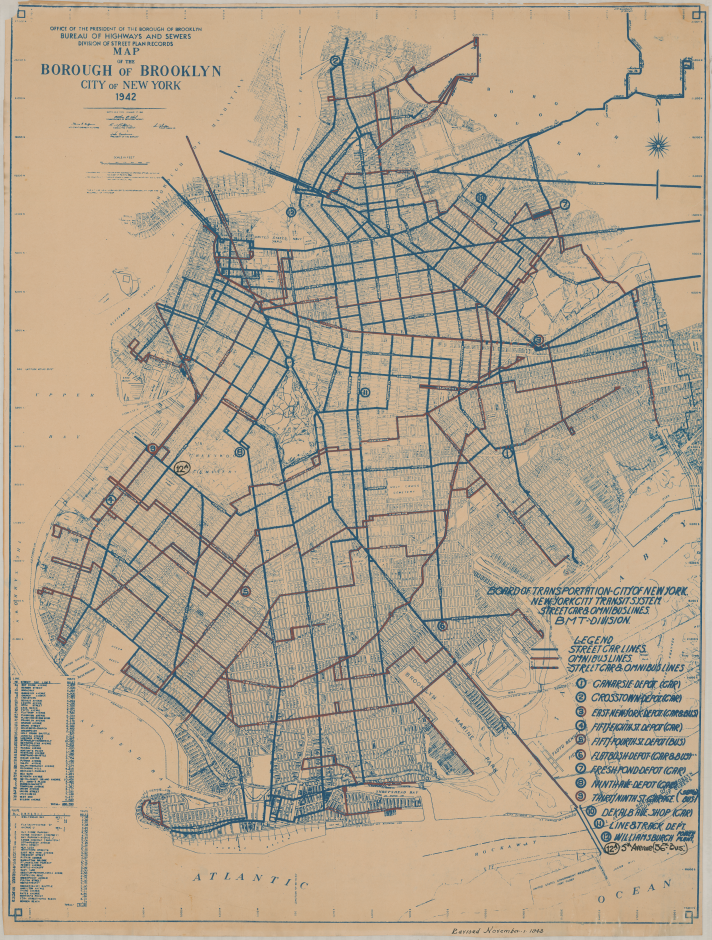
Like our subway network, our bus network is deeply rooted in New York City history. Many of our bus routes look the same as they did as historic streetcar routes. Over the years, the five boroughs have developed rapidly, and current travel needs are not met by the existing network. Redesign is critical for modernizing bus service.
Image courtesy of the New York Transit Museum Archive
How redesigns improve bus service
Riders can expect the following improvements with a redesigned bus network:
- More reliable service
- Faster travel
- Better connections within boroughs and to other boroughs
- A simplified network that is easier to understand
- Improved stop spacing to speed up buses and improve reliability
- An all-day frequent network of routes that run every ten minutes or better
- Collaboration with the New York City Department of Transportation to implement targeted bus priority projects to improve travel times and reliability for bus riders
The process for redesigning a bus network
The bus network redesign process is a multi-year planning effort that engages the public in every step of the process. In 2026, after the successful completion of three network redesigns, we are updating our phase and report names with the goal of clarifying this process for our stakeholders.
Planners analyze the existing network conditions based on data and public feedback to develop a Draft Plan, which shows redesigned routes, stops, frequencies and service spans. After receiving feedback on the changes proposed in the Draft Plan, the network will be redrawn a second time and released in a Revised Draft Plan (formerly called the Proposed Final Plan). Another public outreach campaign is held, which includes a public hearing on the plan proposals. Using the feedback from the outreach campaign and public hearing, the network is revisited for a third time to develop a Final Plan (formerly called the Proposed Final Plan Addendum), which reflects the final network to be voted on by the MTA Board. Once the plan is approved, a robust public awareness campaign is held over the course of several months before and during implementation of the Final Plan.
- Project launch and public outreach
- Analyze data and develop Existing Conditions report
- Redraw network and develop Draft Plan
- Draft Plan public outreach
- Redraw network and develop Revised Draft Plan (previously named Proposed Final Plan)
- Revised Draft Plan public outreach
- Public hearing
- Revise network and develop Final Plan (previously named Proposed Final Plan Addendum)
- MTA Board vote
- Educational campaign on Final Plan
Redesigns by borough
Staten Island
On August 19, 2018, the Staten Island Express Bus Network Redesign was implemented.
Tradeoffs in bus network redesign
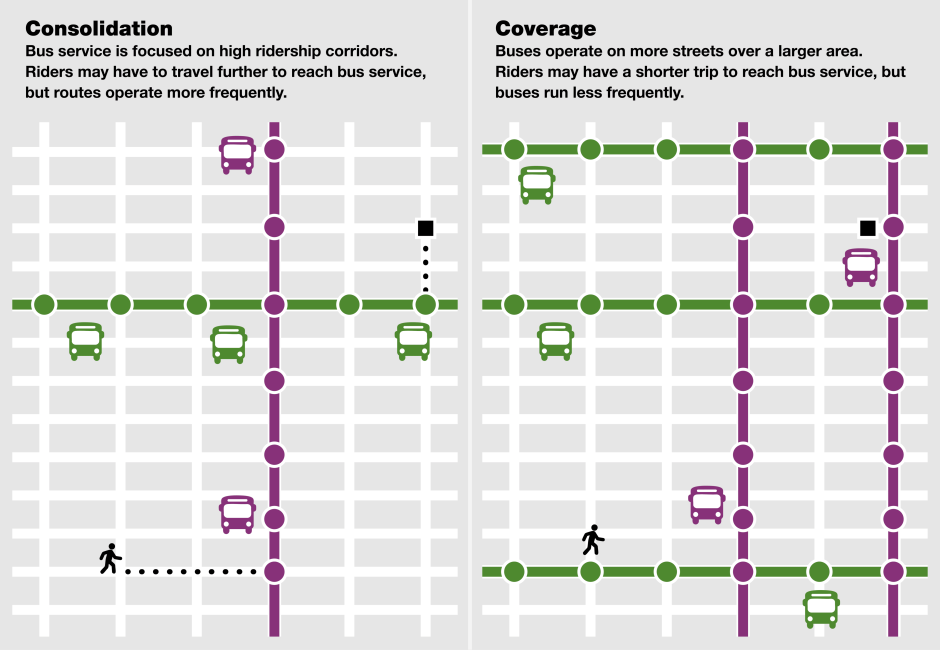
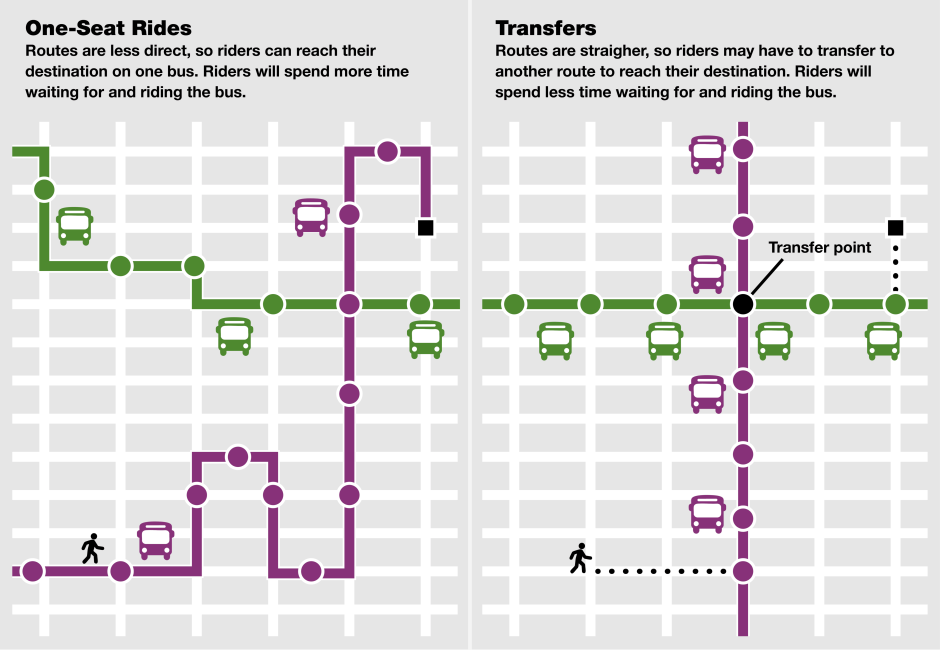
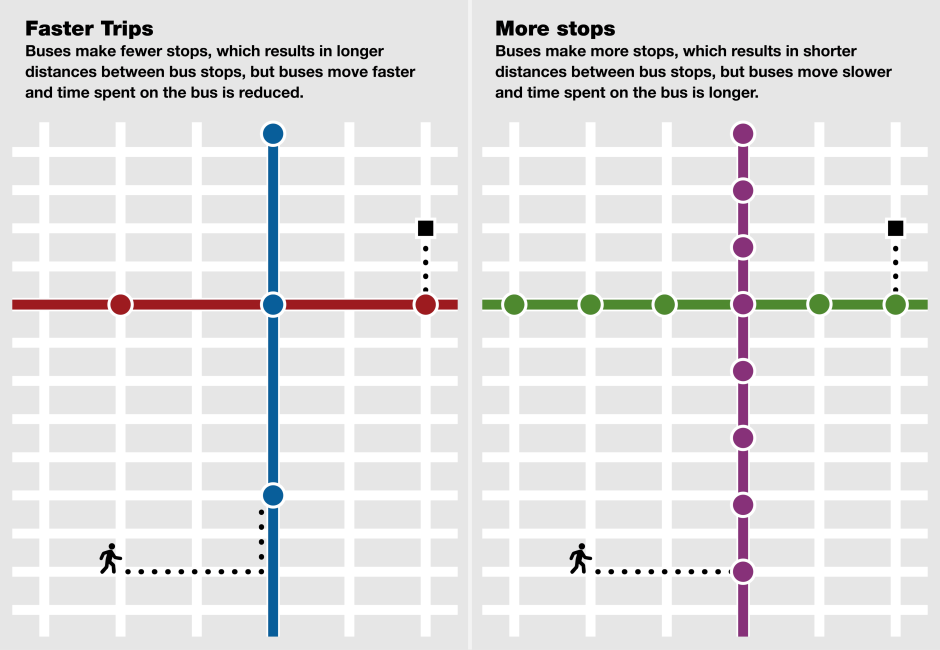
Due to operating resource constraints, the MTA and riders must strike a balance to create a better bus network. Working together to answer questions like the ones posed below, the transit agency and the public determine how to prioritize certain features over others and allocate resources accordingly.
Here are some examples of tradeoffs cities and communities make during the redesign process:
Consolidation versus coverage
One-seat rides versus transfers
Faster trips versus more stops
Routes and stops
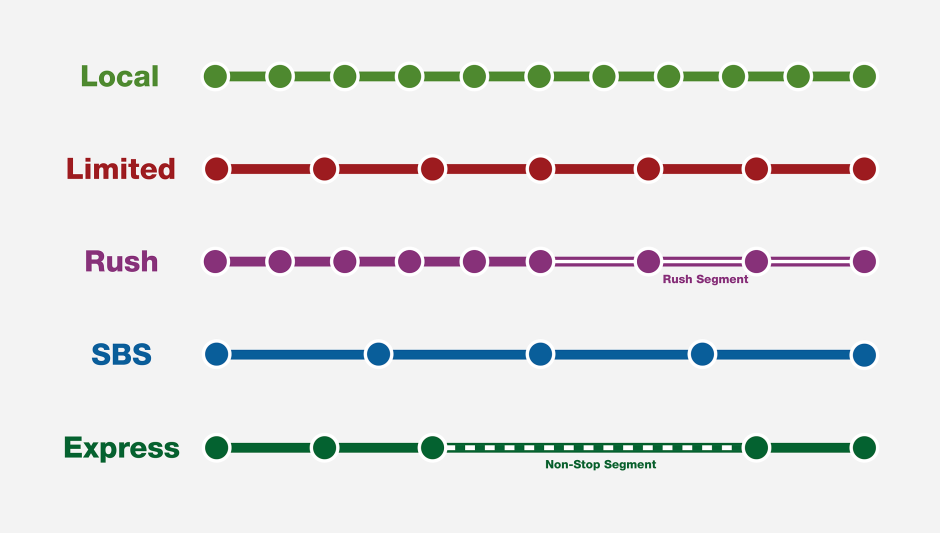
The MTA’s fully redesigned bus network will consist of the following five route categories. Together, these route types provide varied service types to meet diverse rider needs.
Based on local conditions – including ridership, land use, and block length – some route averages will fall below the typical stop spacing and some route averages will fall above.
For all route types, the distance between consecutive stops should not be less than 750 feet unless one or both closely spaced stops are:
- Transfer points.
- Adjacent to key destinations such as schools, hospitals, or senior centers.
- On a hill or other difficult terrain/land use.
- In areas with a high concentration of seniors (75+) or people with disabilities.
Route types
Each distance refers to the average stop spacing for an entire route (or, for Rush routes, a section of a route).
Local
- Average bus stop spacing: 1,000-1,320 feet (1/4 mile). The distance between consecutive stops should generally not be less than 750 feet or exceed 1,500 feet.
- Frequencies based on ridership in the areas they serve
- Connect between neighborhoods, transfer points, and key destinations
For some stops on local routes, the distance between stops may exceed 1,500 feet if an intermediate stop cannot be added because:
- The surrounding land use makes adding a stop infeasible (e.g. large parks, bridges, tunnels, busy or extensive driveways).
- The bus stop location would create operational challenges for the route.
- There is no or limited safe pedestrian infrastructure, such as crosswalks.
- A bus cannot safely stop in the opposite direction. Stop pairs are strongly preferred so riders can easily find their stop in the opposite direction.
Limited
- Average bus stop spacing: 1,760 feet (1/3 mile)
- Frequent all-day service
- Stops located at high ridership locations or major transfer points and destinations
- Combine with SBS and Rush routes to form a high-frequency core network
- Serve high-ridership, high-density areas
Rush
- Average bus stop spacing: 1,000-1,320 feet (1/4 mile) in local segment, 1,760 feet (1/3 mile) in limited segment
- More frequent in AM/PM peak periods
- Combine with SBS and Limited routes to form a high-frequency core network
- Quickly connect neighborhoods in local segment to the subway, high ridership transfer points, and key destinations in limited segment
Select Bus Service (SBS)
- Average bus stop spacing: 2,640 feet (1/2 mile)
- Frequent all-day service
- Have busways or bus lanes on a significant portion of their route length
- Stops located at high ridership locations or major transfer points and destinations
- Bus stops with amenities
- Combine with Limited and Rush routes to form a high-frequency core network
- Serve high-ridership, high-density areas
- Some SBS routes without an underlying Local route have closer average stop spacing
Express
- Average bus stop spacing: 1,760 feet (1/3 mile), excluding non-stop segment
- Connect neighborhoods in the outer boroughs to the central business district of Manhattan
- Charge premium fare
- Long non-stop segment along high-speed corridor
- More frequent in AM/PM peak periods with little off-peak/weekend service
Why your bus stop may change
While it may be convenient to have a bus stop right outside your door, too many bus stops dramatically slow down buses, worsening reliability. Each time the bus stops, it must exit traffic, load and unload passengers, and wait to reenter traffic, resulting in decreased speed and increased travel times. By maintaining appropriate spacing between bus stops, we can keep buses moving with the flow of traffic and get riders where they need to go more quickly.
Note that from 10pm to 5am, customers on local and express routes can ask their bus operator to let them off at locations that aren’t bus stops.