This Wednesday, May 6, the New York City Council is holding an oversight hearing on Fair Fares NYC, the City of New York’s flagship transit affordability program providing half-priced travel for low-income New Yorkers. As lawmakers and policy experts consider the future of Fair Fares NYC, this Policy Brief outlines how the program works and how Fair Fares NYC riders use the transit system today.
Mass transit keeps New York affordable
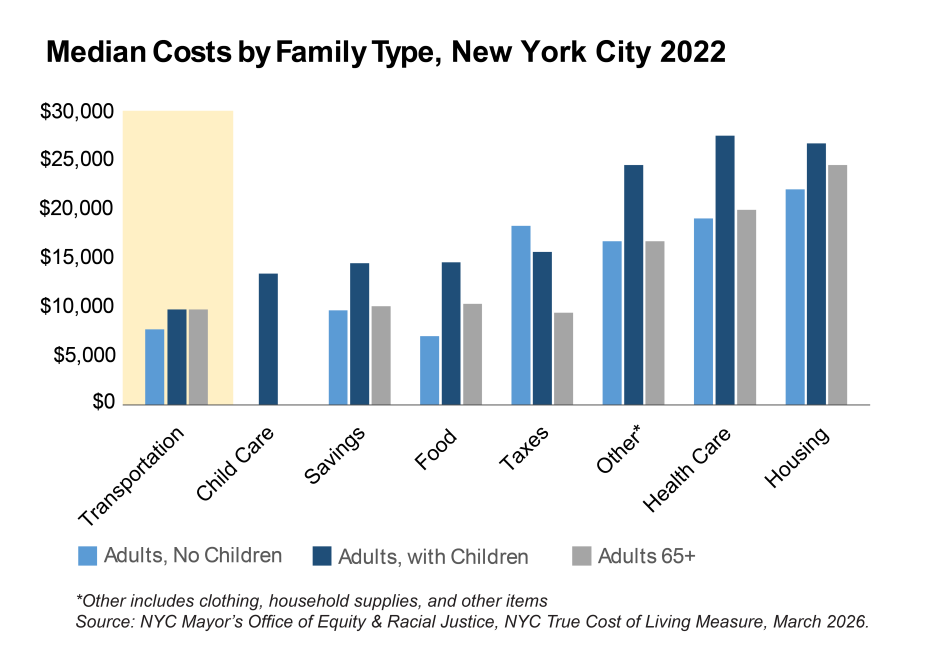
Because of the MTA’s vast transit network—operating 24 hours a day, 7 days a week, 365 days a year—New Yorkers spend less on transportation than most other everyday essentials. A report issued last month by the NYC Mayor’s Office of Racial Equity and Justice on the True Cost of Living found transportation costs are among the lowest share of New Yorkers’ household spending. Housing and healthcare costs were the highest expenses, more than 2.5 times greater than transportation costs. That’s because NYC residents can walk, bike, or rely on subways and buses and are less likely to own a car, which the New York State Comptroller estimates is four times more expensive than transit.
Fair Fares NYC riders pay 45% less per ride today than they did before the program started
Fair Fares NYC, the City of New York’s flagship transit affordability program, provides half-priced subway and bus fares for low-income New Yorkers. NYC residents enrolled in the program pay $1.50 per ride—half the full fare—and no more than $17.50 per week. That means Fair Fares NYC riders are paying about 45% less per ride today in today’s dollars than they were in 2018 when the base fare was $2.75, before Fair Fares NYC started. Plus, the last time a rider paid $1.50 for the subway or bus was in 1995. When adjusting for inflation, the cost per ride for a Fair Fares NYC rider today is comparable to a subway or bus fare from 1953 to 1966, when it cost 15 cents a ride.
Furthermore, with City and State support, the MTA has made transit affordable for even more New Yorkers. Through existing programs like MTA Reduced Fare and Student OMNY, over 2 million seniors, people with disabilities, and students get discounted or no-cost subway and bus fares. Plus, all riders can get discounts like fare capping on subways and buses, and CityTicket for a flat fare on LIRR and Metro-North trips within New York City.
The City of New York funds and administers Fair Fares NYC, and works with the NYC Council to set program eligibility limits
Each year through the City’s budgeting process, the Mayor and New York City Council determine the program’s funding level and set the income eligibility threshold. The City pays for the fares covered by the program, reimbursing the MTA every month based on how many trips Fair Fares NYC customers take.
The New York City Department of Social Services is responsible for administering the Fair Fares NYC program, which includes:
- Verifying applicant eligibility, including age, residency, and income documentation
- Processing new enrollee applications and annual renewals
- Distributing Fair Fares OMNY cards
- Marketing the program and conducting public engagement
- Reimbursing the MTA for rider usage every month
Many low-income New Yorkers earn too much to qualify for Fair Fares NYC
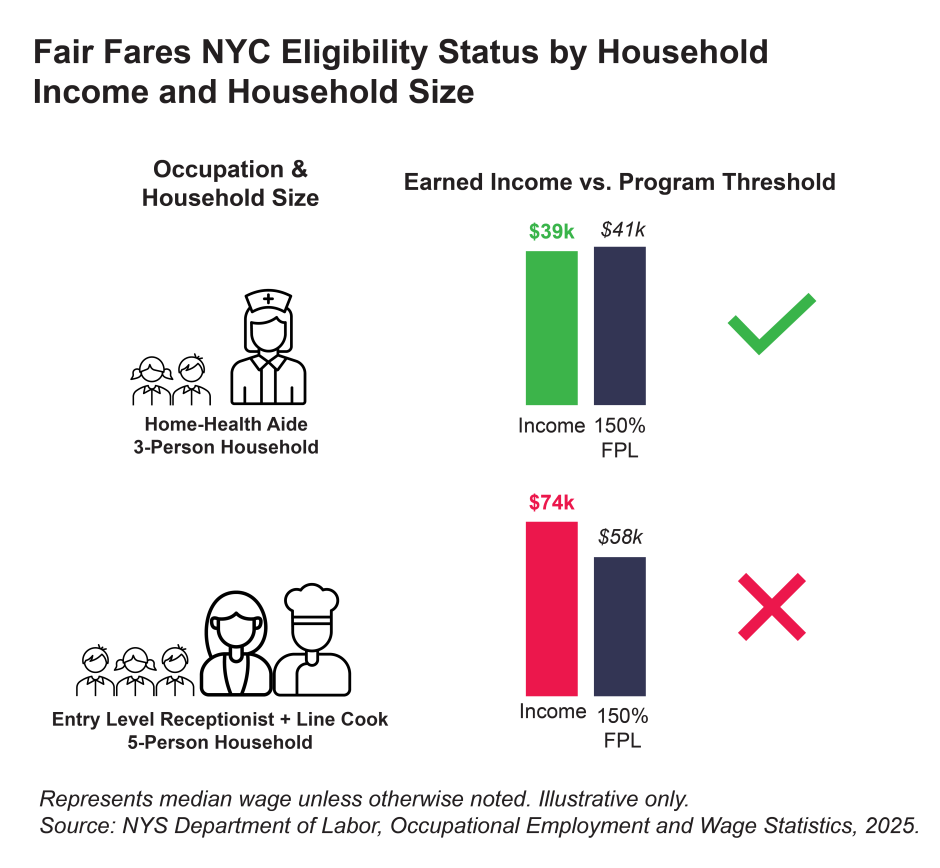
To qualify for Fair Fares NYC, applicants must be aged 18 to 64 and have an annual household income at or below 150% the federal poverty level (FPL), a national guideline set by the U.S. Department of Health and Human Services based on household size and income. That represents approximately 1.2 million New Yorkers today.1
These federal income limits set a national standard—they are not adjusted for regional costs of living, and the income threshold can be too low to include many low-wage NYC workers, particularly those earning the minimum wage. For a New Yorker earning the minimum wage and working 40 hours a week, they take home approximately $35,000 annually before taxes, exceeding the Fair Fares income threshold if they live alone or with a child. The same can be true for a two-parent household where both adults are earning the minimum wage.
Fair Fares NYC enrollment has slowed, but it ticks up each time the City raises the eligibility threshold
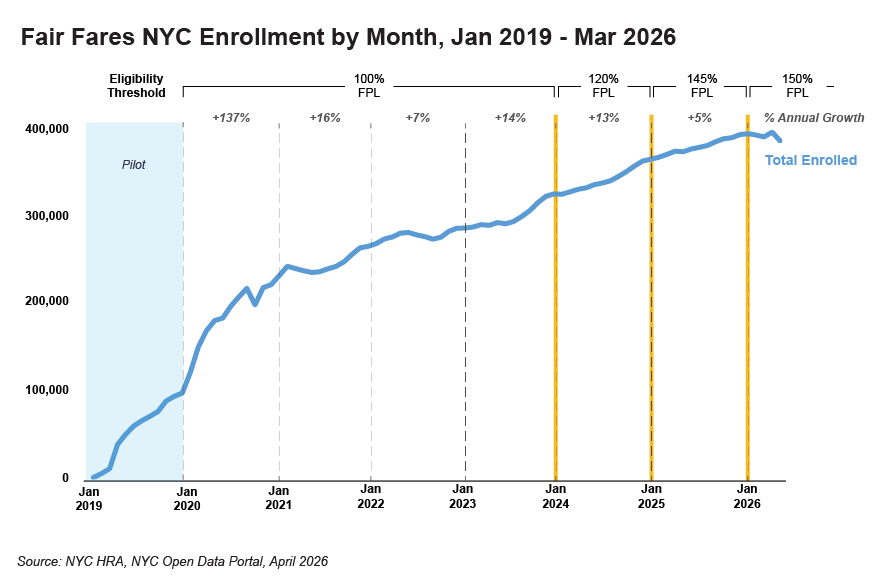
Following a limited pilot program in 2019, Fair Fares NYC opened to public enrollment for eligible NYC residents earning up to 100% FPL in January 2020. Enrollment grew dramatically in the year following initial launch, jumping 137% from around 96,000 pilot participants in December 2019 to 228,000 by December 2020. Yet as the threshold stayed at 100% FPL, enrollment slowed, growing by 16% from December 2021 to December 2022, and 7% from December 2022 to December 2023.
Annual increases to the income threshold in 2024 and 2025 added nearly 400,000 New Yorkers to the eligible population, and the rate of enrollment increased each year at varying rates. However, there are still hundreds of thousands of eligible NYC residents who are not enrolled in the program, which illustrates the need for continued marketing and engagement to supplement increases to the income threshold.
The MTA helps with Fair Fares NYC enrollment through its own customer outreach and marketing campaign
While the City is wholly responsible for shaping, funding, and administering Fair Fares NYC, the MTA recognizes the importance of deepening transit affordability and access for New Yorkers most in need. That’s why we have voluntarily supplemented the City’s efforts over the last few years with our own funding and staff resources, notably as program enrollment has slowed, by:
- Enabling program enrollment at 30 Customer Service Centers (open 24/7), mobile sales vans in all five boroughs, and at 3 Stone Street in Lower Manhattan;
- Helping customers add funds to Fair Fares NYC OMNY Cards and providing general tap and ride technical support; and
- Partnering with the City on advertising campaigns and bi-monthly in-station enrollment events, among other promotional activities.
Evaluating rider travel behavior can help policymakers better understand and improve Fair Fares NYC
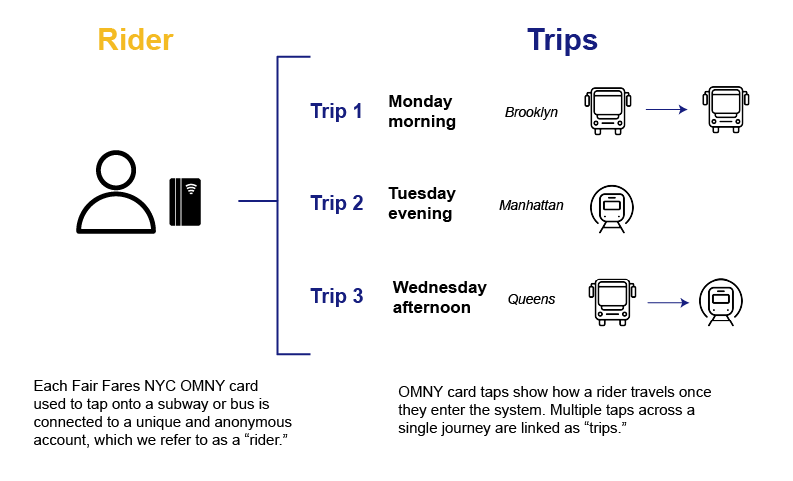
While the MTA does not have direct access to the City’s enrollment data, we can analyze Fair Fares NYC transactions on subways and buses to help decisionmakers understand how program participants use transit. Each Fair Fares NYC OMNY Card is associated with a unique and anonymous account, which we refer to as a “rider.” Once a rider taps into the system, they begin a “trip.” Here’s what that can look like:
In this brief, we explore Fair Fares NYC riders travel patterns relative to non-Fair Fares NYC rider populations, also referred to as “non-Fair Fares NYC riders”, which includes full fare and other riders.2
Fair Fares NYC riders are frequent transit riders and predominantly use the subway
While transaction data cannot tell us who our riders are, it can tell us how much and how often they ride, the modes they choose, and where they enter the system. Here are a few key findings from our analysis:
1. Fair Fares NYC trips represented 4% of all trips on subways and buses in 2025.
In 2025, there were 58.9 million trips taken on subway and bus using Fair Fares NYC, compared to the 1.5 billion trips taken across the system. Fair Fares NYC trips grew by 10% over 2024, slightly outpacing the total system growth of 7% year-on-year. And compared to other subsidy programs, Reduced Fares and Student OMNY transactions each represented 7% of system trips in 2025, both of which have higher total enrollment than Fair Fares NYC.
2. As NYC residents, Fair Fares NYC riders travel frequently, with slightly more off-peak trips.
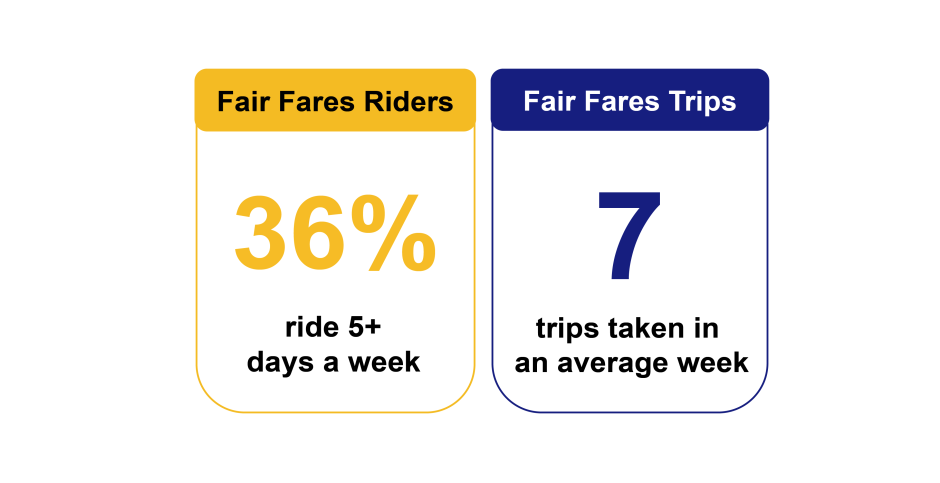
Fair Fares NYC customers are active transit riders. In an average month, slightly more than one-third of Fair Fares NYC customers ride five days or more per week and they take 7 trips throughout an average week. Fair Fares NYC riders are also taking advantage of the weekly fare cap. In an average week, 12% of Fair Fares NYC riders reach the fare cap, double the amount of non-Fair Fares NYC riders.3
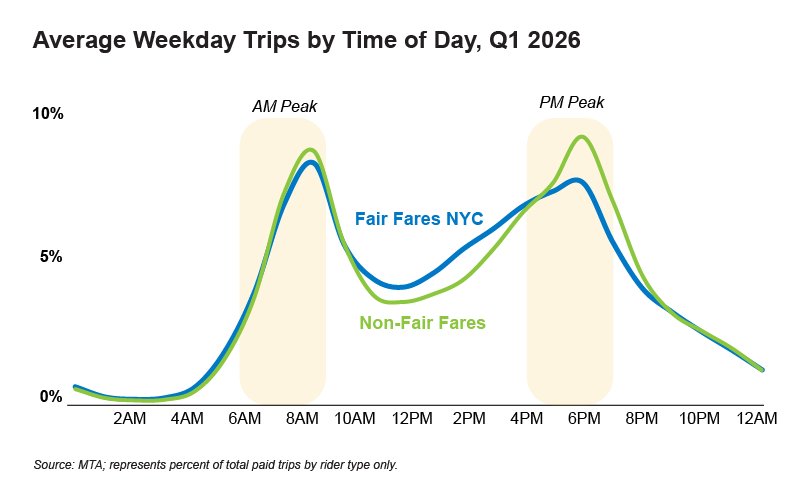
On a given weekday, Fair Fares NYC trips reflect typical commuting patterns with slightly higher off-peak travel. 43% of Fair Fares NYC customers ride during peak AM and PM hours, slightly below non-Fair Fares NYC riders at 47% of trips during the peak. That means a slightly higher share of Fair Fares NYC customers ride during the middle of the day off-peak on weekdays versus non-Fair Fares NYC riders.
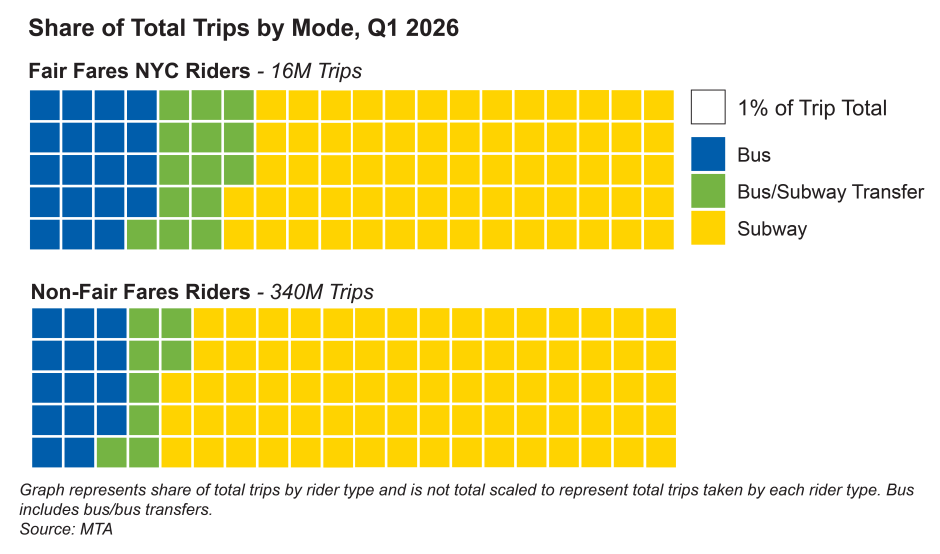
3. Fair Fares NYC riders mostly use the subway, and they also use the bus more than other riders.
In an average month during the first quarter of 2026, 67% of Fair Fares NYC were taken exclusively on the subway, compared to 78% of non-Fair Fares NYC riders. Fair Fares NYC riders took more bus trips and trips that included a transfer between subway and bus as a percentage of all monthly trips compared to non-Fair Fares riders.
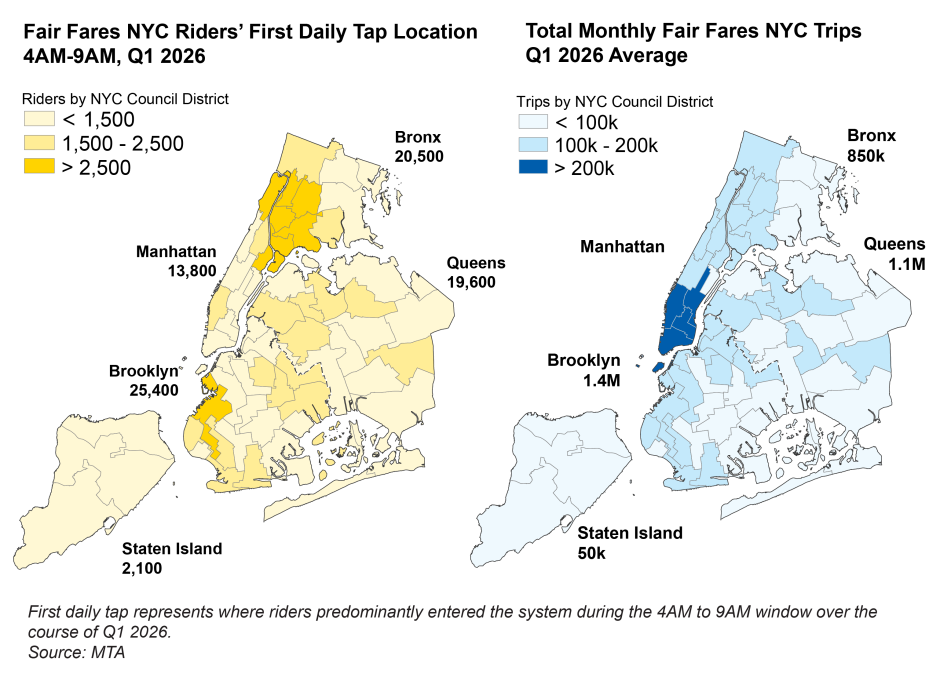
4. Most Fair Fares NYC riders enter the system for the first time each day in Brooklyn, but Manhattan has the highest total Fair Fares NYC usage.
For over 30% of Fair Fares NYC riders—representing over 25,000 riders—their first tap of the day4 is at a Brooklyn subway station or bus stop, followed by the Bronx (25%), Queens (24%), Manhattan (17%), and Staten Island (3%). When looking at the geographic distribution of total trips, most take place in Manhattan (34%) where a significant share of jobs, education, and healthcare institutions are concentrated.
MTA’s customer survey data also helps us understand travel behavior of riders who are eligible but not currently enrolled in Fair Fares NYC—a key program growth opportunity
As the MTA Policy Brief has previously covered, MTA’s customer surveys are an important tool for supplementing what we can learn solely from transaction data. When we conduct our bi-annual Customers Count survey, we ask respondents demographic questions that allow us to determine eligibility for Fair Fares NYC, including their household income, household size, age, and residency.
Findings from the MTA’s Fall 2025 Customers Count survey show that many riders who self-report that they qualify for Fair Fares NYC have not enrolled in the program, despite being frequent transit users. And, like our findings from Fair Fares NYC riders above, eligible but not enrolled riders are high-frequency transit customers: 66% of people surveyed who ride the bus and 62% of those that ride the subway reported they travel in the system five or more days per week.
Eligible but not enrolled riders continue to be the largest near-term opportunity to expand the program and provide more New Yorkers with access to greater economic mobility.
New York City must continue to invest in transit affordability
As we explored in this Brief, Fair Fares NYC enrollees ride frequently and rely on the half-priced fare to use both the subway and bus. The program is critical for connecting New Yorkers to a city of opportunity, enabling low-income residents to more affordably reach their families, better paying jobs, educational opportunities, top healthcare, community services, and iconic cultural institutions.
Today, nearly 380,000 New Yorkers are enrolled in the program, but over one million are eligible. The MTA has advocated prior mayoral administrations and city councils to raise the income eligibility threshold and fund a more robust marketing and outreach program. While the MTA has invested our own resources and staff time to market the program and direct targeted community engagement, more must be done. With a higher income threshold and more resources for marketing, we could reach hundreds of thousands more New Yorkers who are eligible for, but not enrolled in, Fair Fares NYC.
In the coming weeks, the Mamdani administration and City Council will consider how to invest in this critical affordability program. They can make the cost of transit even lower for the residents already eligible for the program or increase the program’s eligibility threshold to make transit affordable for even more New Yorkers. Our data shows that reaching more people currently eligible to enroll and expanding eligibility is a tremendous opportunity. It would extend savings to more riders, provide relief with every tap, and maximize the impact of a program that already helps keep New York City affordable for some of the City’s more active riders. We encourage the City stakeholders to make a data-driven decision that will have the greatest impact on New Yorkers who need it most.
The MTA Policy Brief highlights key policy developments shaping New York’s transportation system. Designed for decision-makers, journalists, advocates, and riders, we explain the most pressing transportation challenges of today and tomorrow, from budget complexities to legislative actions to infrastructure investments. Read more of the Policy Brief.
Footnotes
1. This population includes people with disabilities, who are already eligible to participate in MTA Reduced-Fare. U.S. Census Bureau, “Age by Ratio of Income to Poverty Level,” 2024 ACS 5-Year Estimates, Table B17024.
2. Non-Fair Fares riders include riders who pay the full fare, other subsidized riders (like those enrolled in MTA Reduced-Fare and Student OMNY), and people who pay with coins on the bus. Non-Fair Fares riders represent most transit trip transactions and are mostly full-fare riders. Their travel patterns therefore reflect that of both NYC residents and non-residents (e.g., out-of-state commuters, visitors, tourists).
3. Fair Fares NYC riders’ higher trip frequency likely reflects the general travel patterns of NYC residents, who are more frequent users of the system than non-residents. A large share of non-Fair Fares riders are non-NYC residents and visitors to the city, including suburban commuters and tourists, who travel less frequently than residents and tend to rely more on the subway than the bus. In an average month during Q1 2026, 31% of non-Fair Fares riders took just one or two trips. Though the infrequent riders represent nearly one-third of total unique riders, they are only responsible for 3.5% of total trips. Because transactions represent riders in this analysis, additional infrequency may be due to riders using multiple unique fare payment methods (e.g., a physical credit card or smartphone wallet) when tapping into the system.
4. The MTA does not know where Fair Fares NYC riders live. We use the predominant location where riders tap into the system from 4 a.m. to 9 a.m. each day over Q1 2026, by City Council district, to approximate a “home” location. This method may also capture overnight or non-traditional-hour workers who are tapping in as they leave work.