In the Fiscal Year 2027 New York State Budget, MTA committed to adding even more platform barriers to subway stations. This edition of the MTA Policy Brief explores the purpose of the barriers, how riders feel about them, and how more barriers are being delivered in more subway stations.
Since early 2024, the MTA has been installing platform barriers in subway stations
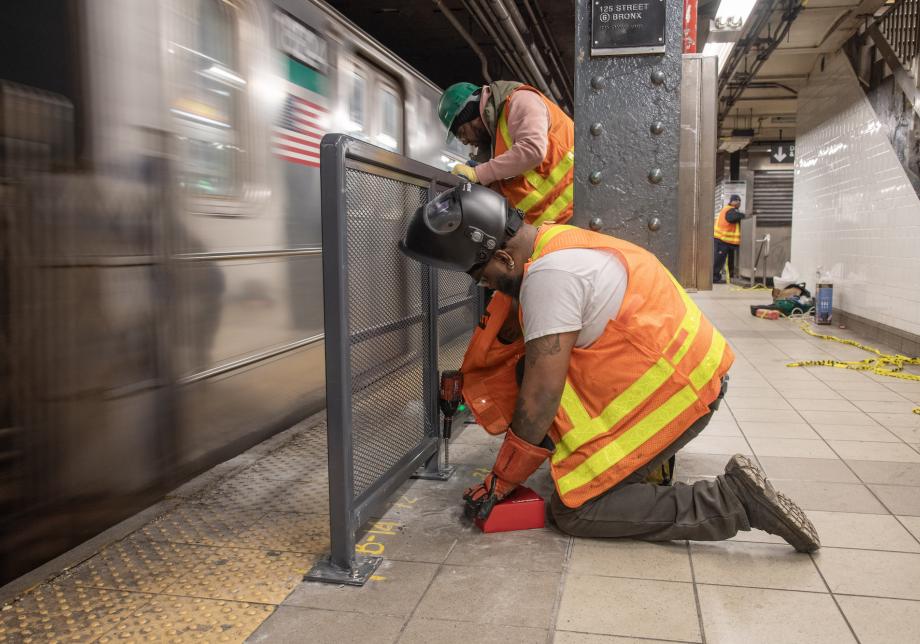
Platform barriers offer a visible, secure barrier riders can stand behind while waiting for a train or walk next to as they move down the subway platform. They are waist-high guardrails positioned in front of the yellow strip and at points along the subway platform where riders can easily enter and exit the train.
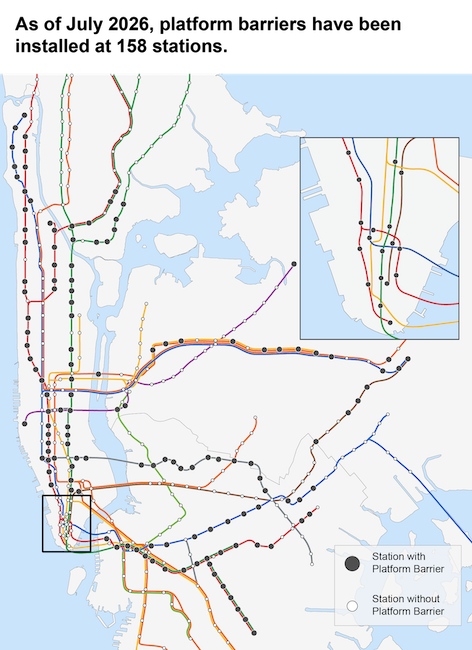
In January 2024, the MTA completed the first installation of platform barriers. After an initial rollout, the MTA accelerated safety improvements and installed barriers at 115 stations by the end of 2025. Now in 2026, MTA is installing barriers in 85 more stations. At the end of June 2026, 43 more stations have barriers, bringing the grand total to 158 stations.
MTA’s in-house teams design, fabricate, and install platform barriers
In 2020, MTA commissioned and published a study to understand the cost and feasibility of installing full screen doors to platforms in subway stations. The study concluded that installing full-height screen doors would only be possible in 27% of stations at a price of $7 billion. As a more immediate, cost-effective, and scalable solution, the MTA introduced platform barriers that will eventually cover the entire subway system.
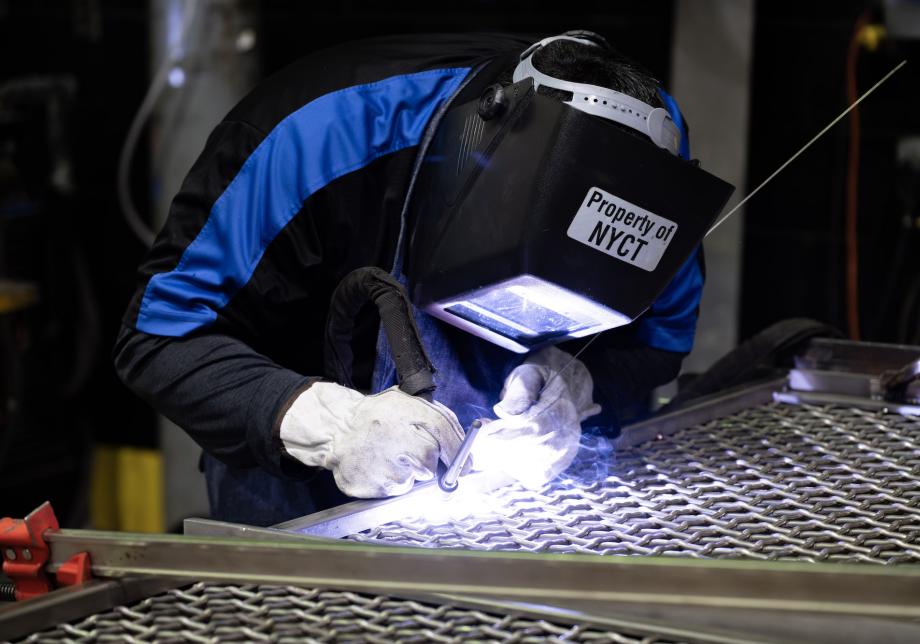
Since starting the platform barrier program, MTA crews at iron shops across the city have designed, manufactured, and installed all the barriers. Welders and machinists co-designed features of the barriers like the curved handrails and corrosion-resistant mesh. Barriers are made from stainless steel, which require less maintenance as they age. In 2025, they fabricated over 1,800 barriers.
Since station layouts vary throughout the subway system, there is no standard barrier design. Welders fabricate barrier segments in a range of sizes from 24 to 144 inches weighing between 100 to 350 pounds to meet the specifications of the station.
In-house teams can also respond to customer feedback. After MTA commissioned the first customer survey on the barriers in 2024, riders gave negative feedback about their yellow color. Workers changed the color to gray, and respondents in later surveys specifically noted the color change as a reason for their higher rating.
MTA teams install barriers faster and more cost-effectively
With in-house crews, the MTA does not need to bid out this work to an external vendor which would drive up the cost of the barriers. With our own crews, the MTA can install barriers at approximately $100,000 per station, compared to $300,000 with an outside contractor.
When MTA Construction and Development proposals for this work, bidders set manufacturing timelines for six weeks. MTA teams can complete the same work in about one week because crews have system knowledge bringing familiarity, tools, and ontheground experience needed to move quickly to different station needs.
This means staff can produce more barriers in less time and get them installed in stations faster.
Riders notice these improvements and support platform barriers
Platform barriers are making a difference in subway riders’ feelings of safety while in stations. The MTA’s in-house Market and Customer Research team asks about riders’ sense of safety in monthly Pulse surveys, as we previously covered in the Policy Brief.
In general, 3 out of 4 riders feel safe in stations and on trains, according to the May 2026 Pulse survey. This has remained steady since May 2025 and is nearly 10 percentage points higher than the beginning of 2025, indicating compounding strategies to improve subway safety makes customers feel safer.
Since 2024, when the first platform barriers were installed, the Market and Customer Research team has fielded 3 waves of surveys to gather feedback on platform edge barriers. Participants are helping the MTA understand if they understand what the barriers are for, if they find the barriers effective, and whether they are seen as an enhancement or inconvenience.
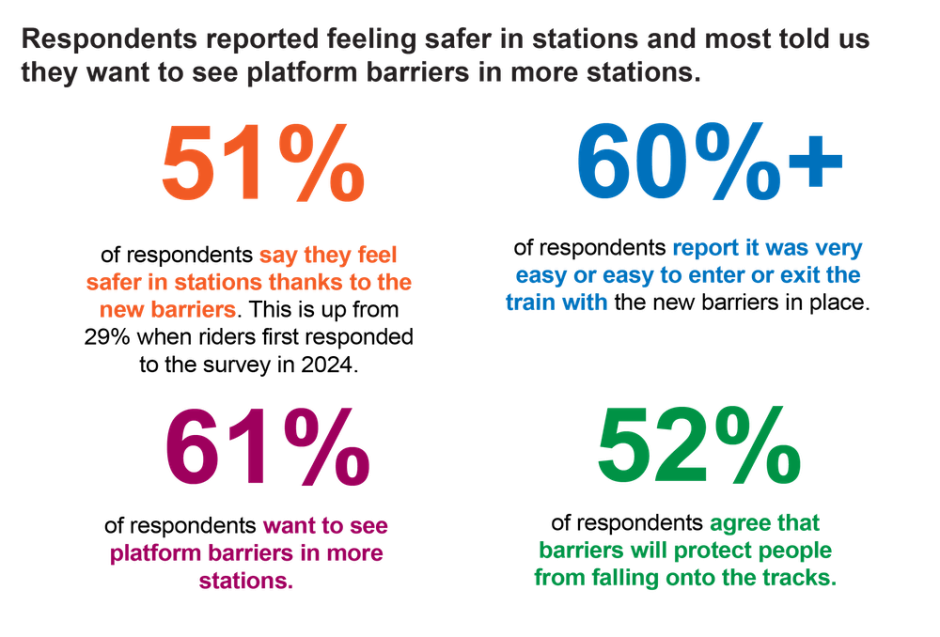
From January to May 2026, respondents reported feeling safer in stations and most noted they want to see platform barriers in more stations:

When someone enters the subway tracks, they risk personal safety, disrupt transit service, and threaten critical infrastructure
Since 2023, incidents of riders ending up on subway tracks has increased for a variety of reasons, like retrieving dropped items or people experiencing mental health crises.
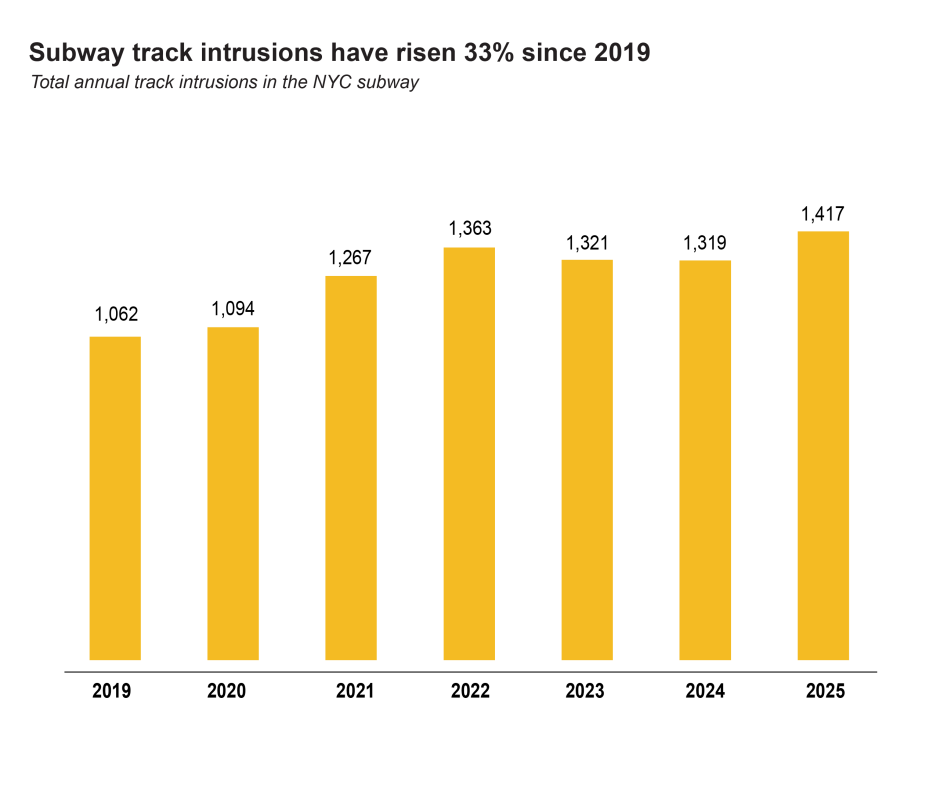
When a rider is on the subway tracks, the MTA follows a response protocol to protect riders, workers, and first responders. Crews halt train service and turn off track power before first responders can enter onto the tracks. While teams are responding to the incident, subway delays build up as trains wait in stations or in tunnels for power to restore, and riders might wait a long time on platforms for the next train.
Track intrusions are a risk to the intruder’s safety, the safety of fellow passengers and can significantly delay subway service. In 2026, customers have been delayed a median of 8 minutes due to all track trespassing incidents. When those incidents include someone who is struck by a train, that figure increases over 9-fold, delaying customers over 1 hour and 15 minutes.
The MTA has a broader strategy to address track intrusions and other safety concerns in the subway
MTA teams are tracking the efficacy of platform barriers in stations, measuring the number of incidents before and after the barriers were installed. In stations with barriers, there has been an 11% decrease in accidental or unintentional track trespassing incidents. Security teams at the MTA continually monitor track intrusion data to understand how to deploy resources as needed.
In addition to platform barriers, MTA is also making physical safety improvements across the subway network to deter crime, improve incident response, and make stations more comfortable. Taken together, at the end of 2025, subway crime fell to its lowest level in 20 years.
The MTA Policy Brief highlights key policy developments shaping New York’s transportation system. Designed for decision-makers, journalists, advocates, and riders, we explain the most pressing transportation challenges of today and tomorrow, from budget complexities to legislative actions to infrastructure investments. Read more of the Policy Brief.