On this page
About our budget
Everything we do begins as a line item in our budget. Our two budgets—the operating budget and capital budget—communicate our priorities and share how we balance service improvements, manage long term expenses, maintain affordable fares, and invest in the future of the public transportation system.
We develop our budgets in a disciplined, consistent, and transparent process. That doesn't mean they are easy to understand. This page will help you better understand the numbers and decisions that make up our budget. We also created a glossary of common budget terms.
For a complete look at our current and past budgets, review our financial documents.
Operating budget basics
The MTA’s operating budget funds the day-to-day costs of running subways, buses, and trains, as well as operating our seven bridges and two tunnels. Its funding helps pay our employees, run trains and buses, and perform daily tasks like cleaning and maintenance. For FY2026, the MTA’s operating budget is $21.3 billion.
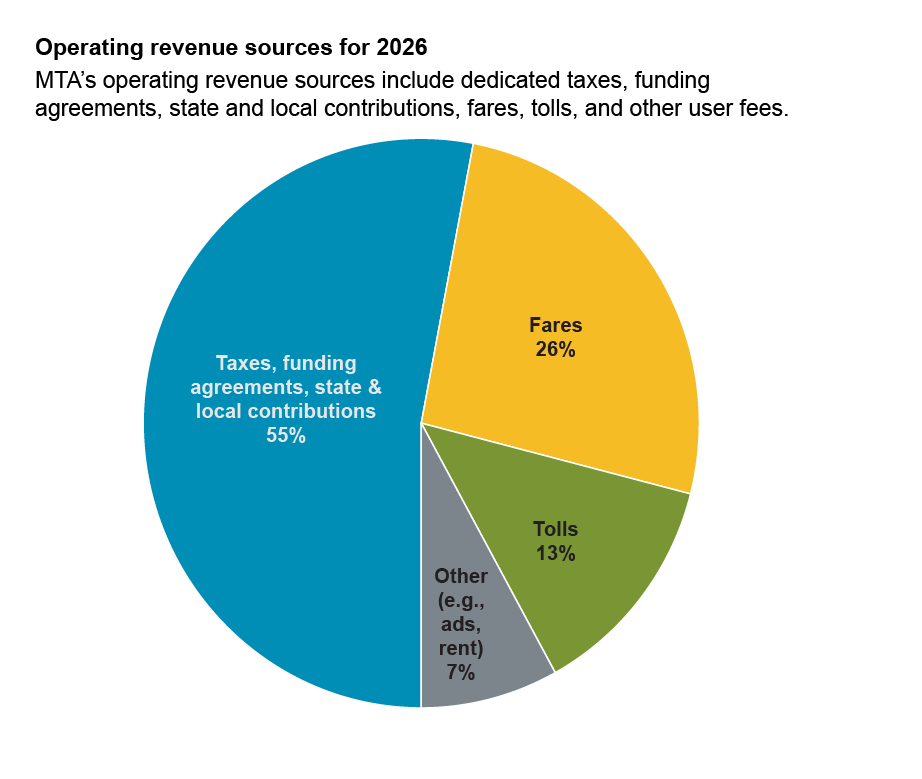
Where operating budget dollars come from
The largest share of MTA revenue, 55%, comes from dedicated taxes and subsidies collected from sources like corporations, sales and real estate transactions, and direct contributions from the City of New York. Fares and tolls comprise 39% of the operating budget, and the rest comes from advertising, concessions, and rent from retail spaces.
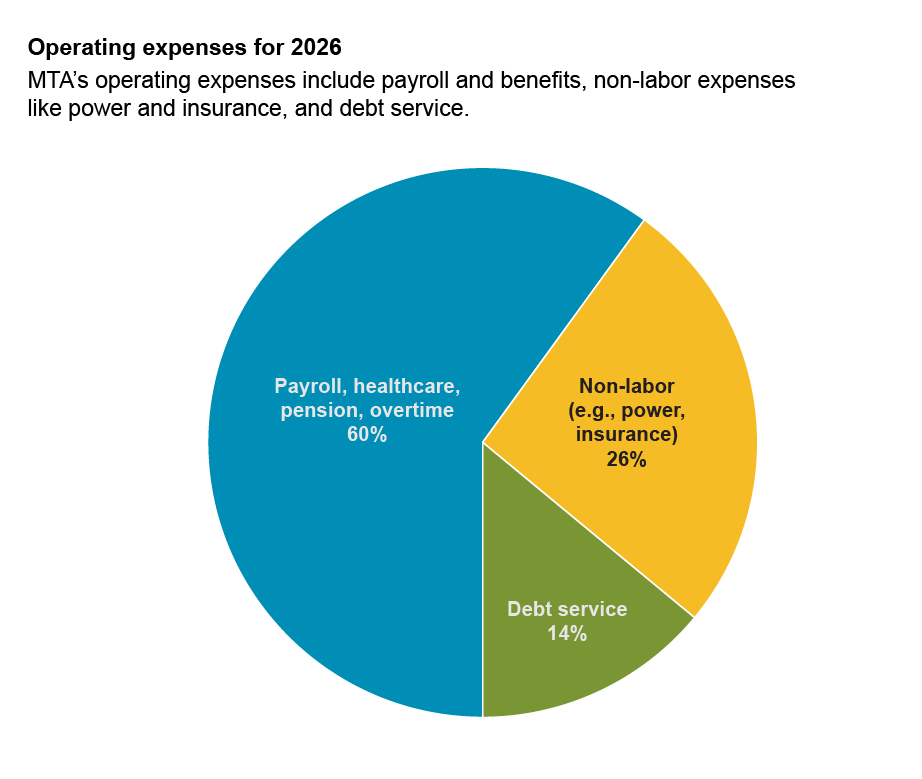
How our operating budget dollars are spent
Mass transit is a people-powered operation. The MTA employs more than 70,000 dedicated workers, most of whom handle the essential, day-to-day tasks that keep the system moving, like driving trains, assisting customers, and cleaning stations. That people-heavy operation makes up about 60% of spending, covering salaries, pensions, and benefits like healthcare. The remaining costs cover utilities and power to keep the lights on and fuel tanks full, and debt service to cover payments on past borrowing.
Capital budget basics
While the operating budget is about keeping the system running today, the capital budget is about making the system better for tomorrow. The MTA develops a capital budget every five years, putting forth major investments in repairs, modernization, and expansion that ensure our infrastructure can continue serving the region for decades to come. Read more about the 2025-2029 Capital Plan.
Where our capital budget dollars come from
The Capital Program is funded through a mix of revenue sources, including taxes, bonds, grants, and dedicated funding agreements. Key sources include the capital lockbox—funded by taxes on payrolls, certain sales, and real estate transfers—and congestion relief tolls. Federal grants support repairs and modernization, while bonds allow the MTA to finance large projects over time. Additional contributions from New York State and City, along with cost-saving initiatives, round out the program.
Where our capital budget dollars go
The MTA funds capital projects across the transportation network that will provide more frequent and reliable service, improve the customer experience, and make the system more resilient. Major investment categories include:
- New subway, bus, and railcar rolling stock, like the new open gangway subway cars on the line.
- Station upgrades such as the reconstruction and modernization of Broadway Junction.
- Accessibility improvements like adding and replacing elevators in stations.
- Expansion projects like Second Avenue Subway Phase 2, the Interborough Express, or the new Grand Central Madison commuter rail terminal.
Every five years, once the MTA Board approves the Capital Plan, it is reviewed by the Capital Program Review Board, composed of representatives from the Governor, Mayor, and legislative leaders, before implementation.
Debt overview
The MTA borrows money by issuing tax-exempt bonds to finance long-term infrastructure improvements that are part of the Capital Program. Bonds are issued under several credits backed by fare and toll revenues, dedicated taxes, subsidies, and other resources, and include both fixed-rate and variable-rate obligations. Each credit is rated by national rating agencies, and ratings are updated with every new issuance. For detailed information on capital projects, debt structure, and current bond ratings, visit MTA investor information.
Dedicated subsidies and how they work
A portion of MTA revenue comes from dedicated taxes and state and local subsidies. Key revenue sources include the Payroll Mobility Tax, Metropolitan Mass Transportation Operating Assistance, Petroleum Business Taxes, and Mortgage Recording Taxes, along with urban taxes on property transfers and for-hire vehicle surcharges. These revenues help cover over 55% of operating costs and support improvements across the transit system. For a full breakdown of taxes and subsidies, visit the MTA’s most recent financial and budget statements.
The budget process
The MTA operating budget goes through a rigorous and in-depth annual process that culminates in the proposed passage of the budget in December. Throughout the year, the MTA prepares three financial plans, in February, July, and November, followed by Adoption Materials in December.
Each plan requires agencies to develop current-year budgets and a four-year projection.
The July Plan offers a revised forecast for the current year, a preliminary budget for the following year, and a three-year outlook, often including gap-closing proposals that may require public hearings. The November Plan updates the July forecast after stakeholder input and risk assessments, finalizing the proposed budget and out-year projections.
In December, the November Plan is refined to reflect new developments and actions needed to maintain balance before being presented to the MTA, Board for review and approval as the Adopted Budget.
Finally, the February Plan incorporates technical adjustments and moves certain policy items into baseline, allocating the Adopted Budget across 12 months. This February Plan becomes the benchmark for monthly performance comparisons throughout the year.
The capital budget process is different from the operating budget. The MTA proposes a new capital budget every five years. The MTA Board approves the Capital Plan, followed by the Capital Program Review Board, which includes representatives from the Governor, Mayor, and legislative leaders. It is then implemented over five years.
Interactive budget visualization
The MTA’s operating and capital budgets are available as interactive, web-based dashboards on the MTA Metrics site and can be downloaded as spreadsheets from the New York State Open Data Portal.